future of work
·
tech leadership·
designThe ROI of UX Design in the Age of AI
Why cheaper execution is making human wisdom—and authentic experience—more valuable
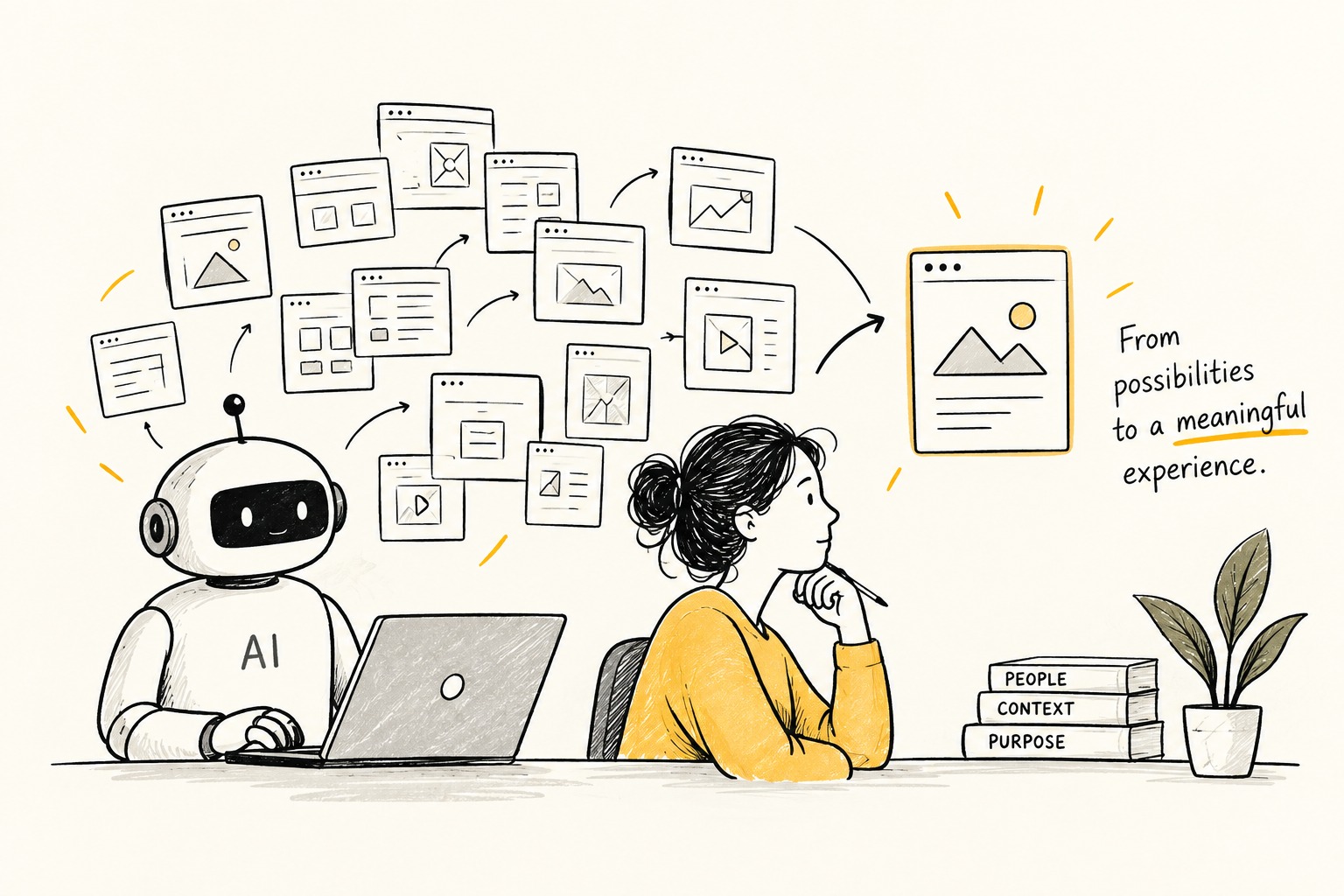
future of work
Why cheaper execution is making human wisdom—and authentic experience—more valuable
Est. Reading Time: 19 minutes
By Nipuna Fonseka
Published On September 12, 2026
The ROI of UX Design is entering a strange new phase. Artificial intelligence has become remarkably adept at producing interfaces. Offer it a prompt and it will generate a landing page. Describe a dashboard and it assembles a polished layout. Outline a mobile application and, within seconds, it can produce typography, colour palettes, spacing systems and component libraries that would have required days of work only a few years ago.
The acceleration is extraordinary, but beneath the excitement lies an uncomfortable discovery. The ability to produce something attractive is not the same as the ability to produce something useful, meaningful or successful. (see AI Slop, Game Slop, <Insert Word> Slop)As the cost of generating interfaces falls, the question facing designers and organisations is shifting.
That distinction sits at the heart of the ROI of UX Design in the age of AI. Artificial intelligence is rapidly commoditising execution. It can generate more options, more quickly, and at a quality that would have seemed implausible only a few years ago. Yet as execution becomes inexpensive and abundant, another resource becomes comparatively scarce: the wisdom to know what should be created, for whom, in what context and to what end.
UX is increasingly the discipline through which that wisdom becomes tangible. Beneath conversion rates, retention figures and operational efficiencies, there may also be a deeper return: the creation of an authentic human experience.
For a long time, creativity appeared to belong almost exclusively to humans. Artists painted, designers created interfaces, architects imagined buildings and writers told stories. Creativity itself seemed to be one of the qualities separating human work from mechanical production.
Generative AI unsettled that assumption with astonishing speed. It can generate thousands of concepts faster than an entire design department, imitate established styles, synthesise disparate influences and produce polished work from almost any prompt.
The question this creates is not merely professional. It is philosophical.
If machines can produce things we recognise as creative, what exactly did we mean by creativity in the first place? Perhaps we confused creativity with production.
The ability to generate novelty is certainly part of creativity, but it may never have been its most consequential part. Human creativity also involves recognition: recognising what deserves attention, what matters in a particular moment, what should be discarded, what should be developed and why one possibility carries greater meaning than another.
AI can make the field of possibility almost limitless. Yet abundance does not remove the need for choice. It makes choice more important.
A designer who once produced three plausible directions may soon have three hundred. The difficult question is no longer how to produce another option. It is how to determine which possibility deserves to become reality. This is where creativity begins to converge with judgement.
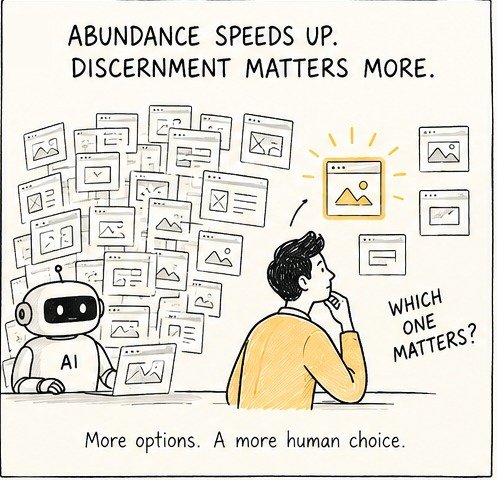
There is already evidence of this paradox. A 2024 Science Advances experiment found that access to generative AI improved the perceived creativity and quality of individual stories, particularly for less creative writers. Yet the AI-assisted stories also became more similar to one another. AI increased individual creative performance while reducing collective novelty. DOI
That distinction matters. The problem may not be that AI produces inferior creative work. It may be that, when everyone draws from increasingly similar generative systems, competent output becomes abundant while distinctiveness becomes scarce.
Much of the public conversation about AI and design continues to revolve around replacement. Will AI replace UX professionals? Are product teams becoming smaller? Do organisations still need people who can create interfaces when an AI system can produce one instantly?
This framing misses something fundamental.
Software is rarely created simply to demonstrate our ability to design software. It exists because a human being wants to accomplish something: book a flight, pay an invoice, understand a medical result, manage anxiety, educate a child, communicate with another person or operate a business.
Every interface exists in service of human intention.
Seen from that perspective, the purpose of UX becomes clearer. Its deepest value has never rested in producing visually appealing screens. It lies in translating human intention into systems that people can understand, trust and use with confidence. That translation begins well before the first pixel appears. It starts by understanding what the person is actually trying to do, what they already know, what they fear, what they misunderstand, which pressures surround their decision and what happens if they get it wrong.
AI may be able to generate the interface but UX asks whether it is the right interface, for the right person, at the right moment. Those are very different problems.
Historically, production itself imposed a natural constraint on design. Research, wireframes, layouts, component systems, prototypes, iterations and high-fidelity screens all demanded significant time and expertise. Because creating alternatives was expensive, much of the perceived value of design resided in the ability to create them.
AI has removed that constraint.
What remains stubbornly difficult is understanding people: why someone hesitates before clicking, why a customer abandons a checkout after investing ten minutes in it, why one workflow feels effortless while another creates frustration, and why two audiences looking at the same interface interpret it completely differently.
The problem described by a stakeholder can also bear surprisingly little resemblance to the problem experienced by the person actually using the product.
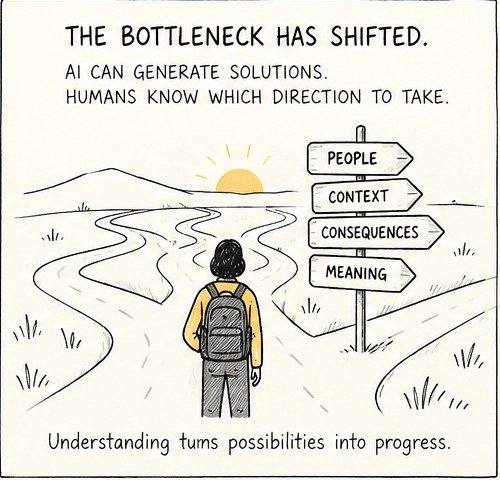
AI can generate interfaces with remarkable fluency, but fluency is not discernment. It can propose solutions within an enormous possibility space. Determining whether those solutions should exist at all, whether they solve the right problem and whether their consequences are desirable still requires judgement.
The bottleneck has therefore not disappeared. It has moved from production to interpretation, from generating options to choosing between them, and ultimately from technical capability towards human wisdom.That shift is fundamental to understanding the ROI of UX Design today.
A broader pattern is emerging far beyond design. As knowledge becomes abundant, wisdom becomes scarce. Knowledge can now be retrieved, summarised, recombined and generated almost instantly. An AI system can explain established practices, analyse research, compare design patterns and identify correlations at extraordinary speed.
Wisdom is something different.
Knowledge may tell us that reducing the number of steps in a process usually improves completion. Wisdom may recognise that, in a financial or healthcare context, an additional step creates reassurance and trust. Knowledge may suggest that automation reduces friction. Wisdom may recognise that removing human contact at a particular moment makes a vulnerable customer feel abandoned.
Knowledge identifies patterns. Wisdom recognises when the pattern does not fit the person standing in front of us.
This distinction is more than philosophical because every decision eventually acquires an economic consequence. A poorly judged interaction can reduce adoption, increase support requests, damage trust or send development effort in the wrong direction. Better judgement improves both the experience and its business value.
Perhaps there is something fitting in the fact that our own species carries the concept in its name: Homo sapiens—the wise human. Our evolutionary advantage was never simply speed or strength. Human survival has depended upon interpreting context, collaborating, detecting subtle signals and making consequential decisions with incomplete information.
Those capabilities are remarkably close to the qualities that distinguish exceptional UX.
In design, wisdom is therefore not an abstract virtue. It is the practical synthesis of experience, empathy, context, judgement and responsibility.
Every AI system benefits from context. Better prompts, stronger source material and clearer constraints generally produce better outputs. However, meaningful human context cannot simply be reduced to a sufficiently detailed prompt.
A product exists within a world already inhabited by the person using it. They arrive with memories, assumptions, expectations, frustrations, cultural norms, competing priorities and an emotional state that may change from one moment to the next. Their interaction with the interface is only a small fragment of a much larger lived experience.
A good UX process therefore asks questions that interface generation alone cannot resolve. These are not primarily questions about screens. They are questions about people.
The interface is the visible expression of the answers.
AI can help organise research, reveal patterns, model alternatives and explore possible solutions. Those capabilities are enormously useful. Yet the act of interpreting what those patterns mean for another human being remains one of the most consequential parts of design. Context is not simply information supplied to a machine. It is meaning interpreted in relation to a human situation.
This view of design is not merely philosophical. ISO 9241-210 treats human-centred design as a set of principles and activities applied throughout the life cycle of an interactive system, rather than a final visual-design stage. ISO NIST's Generative AI Profile similarly emphasises understanding the intended context of use, users, assumptions, social expectations and potential impacts when evaluating generative AI systems.
There is also a danger in mistaking increasingly persuasive output for increasingly sound judgement. NIST identifies both automation bias and over-reliance as risks in human–AI interaction: as generative systems become more reliable, people may defer too readily to their outputs or assume that AI-generated content is inherently higher quality. NIST Publications
The better AI becomes at producing plausible answers, the more important the human capacity to interrogate those answers may become.
Many organisations still evaluate design primarily through appearance. Does it look modern? Does it feel premium? Is it consistent with current trends? Does it resemble products people already admire?
These questions matter, but they are insufficient.
People rarely engage with software simply to admire it. They arrive because they need to accomplish something. Effective UX reduces cognitive effort, removes uncertainty, builds confidence, prevents costly mistakes and helps people move towards an outcome without unnecessary friction.
This is where commercial value begins to emerge.
A visually impressive checkout that confuses customers is still a commercial failure. A sophisticated dashboard that obscures the information required to make a decision is still a commercial failure. A beautifully designed healthcare application that increases anxiety at a vulnerable moment may be both a human and commercial failure.
The obvious case is terrible usability. It is easy to understand how a broken checkout or incomprehensible workflow destroys value. The more interesting cases are subtler: experiences that technically work, but introduce just enough uncertainty, effort or mistrust to alter behaviour.
Aesthetics contribute to experience, but they are not synonymous with it. The purpose of design is not simply to make the artefact impressive. It is to make the interaction meaningful.
There is another consequence of abundant AI-generated design that is beginning to become visible.
As the same systems are used to generate more websites, applications, imagery and copy, there is a natural tendency towards convergence. Certain layouts recur. Visual treatments become familiar. Language shares a recognisable cadence. Interaction patterns repeat across products that have little relationship to one another.
The problem is not necessarily that people consciously identify an interface as AI-generated. That claim is both difficult to prove and ultimately less interesting.
What people are extraordinarily sensitive to is the absence of specificity.
An experience can feel as though it was designed for anyone and therefore, paradoxically, for no one in particular. It may be technically competent yet strangely anonymous. Nothing about it is obviously wrong, but nothing demonstrates that the organisation deeply understands the person using it either. Human beings are powerful pattern-recognition systems. Given enough exposure, we notice sameness even when we struggle to articulate exactly which cues produced that impression.
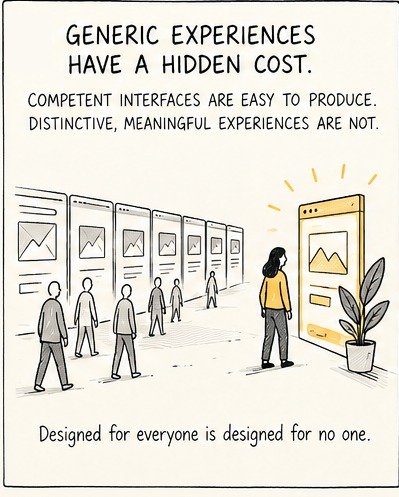
This becomes commercially important because perception affects trust, trust affects behaviour and behaviour affects business value.
A generic experience can unintentionally communicate that very little thought was required to produce it. In healthcare, finance, education, professional services and enterprise software, the perception of care is not ornamental but becomes part of the product itself.
The role of UX is therefore not to disguise the involvement of AI. It is to ensure that the resulting experience could only have emerged from a serious understanding of the people it was created for. Specificity is one of the signatures of care.
Recent interface research suggests that this effect is not confined to writing. A 2026 study comparing AI-generated and human-created interface prototypes found that participants rated AI-generated interfaces positively for pragmatic qualities such as usability and efficiency, while ratings for originality and innovation were neutral or negative. The researchers described the resulting interfaces as “usable but conventional”. arXiv
The conventional business case for UX tends to centre on measurable outcomes such as higher conversion, lower abandonment, reduced support costs, fewer user errors, faster onboarding, stronger retention, increased productivity and revenue growth.
These measures remain important as they demonstrate that UX work is not decoration but a commercial discipline yet most of them are downstream outcomes.
The more consequential investment often occurs much earlier, when an organisation chooses to understand people before it begins building for them. This economic argument is not new. Human Factors International made the case more than a decade ago that poor requirements and weak understanding of users can create substantial downstream development costs. Their classic explanation of the ROI of User Experience remains a useful foundation for understanding why early UX investment matters.
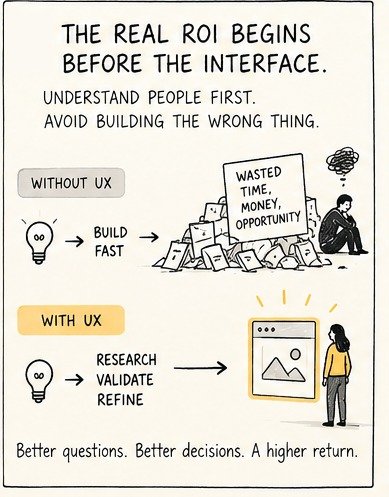
Consider the cost of building the wrong thing efficiently. AI may allow a team to design and develop a feature in a fraction of the time previously required. If that feature solves the wrong problem, however, efficiency simply accelerates waste.
Development consumes resources. Testing, documentation, support and maintenance continue to incur costs. Complexity accumulates inside the product. Meanwhile, the customer may become more confused rather than better served.
There is also an opportunity cost. Every hour spent producing, testing and maintaining something customers did not genuinely need is an hour that could have been invested elsewhere.
This is particularly significant in SaaS products, where features are rarely finished when they ship. They continue to impose design, engineering, documentation, support and cognitive costs for as long as they remain part of the product.
Speed has never compensated for poor judgement.
The ROI of UX Design therefore begins before conversion optimisation or usability testing. It begins when UX helps an organisation determine which problems deserve investment in the first place.The greatest financial contribution of UX may not be improving an interface after it exists. It may be preventing the wrong interface from being built at all.
This is why the classic business case for user-centred design remains relevant even as the tools change.
Human Factors International's well-known The ROI of User Experience made the argument more than fifteen years ago that UX investment can reduce the consequences of badly defined requirements and poor communication between customers, developers and users. Those ideas drew partly on earlier analysis of software failure published by IEEE.
The technology landscape has changed enormously since then, but the underlying economic logic has not. In fact, AI makes it more important because as production becomes cheaper, organisations can build the wrong thing faster than ever before.
The cost of production may fall while the cost of poor direction remains. Major design projects may require fewer hours of manual execution, but the consequences of choosing the wrong problem, wrong workflow or wrong assumption are not automatically reduced with them.
Without understanding, AI produces increasingly polished guesses. With understanding, it becomes an extraordinary amplifier. That difference is where much of the modern ROI of UX Design resides. The economic logic is straightforward. The UK Government Service Standard advises teams to understand the full context of what users are trying to achieve and to test assumptions early, specifically because doing so reduces the risk of building the wrong thing and improves the chance of meeting needs in a simple, cost-effective way. GOV.UK
That is the ROI of UX before a single conversion metric moves: avoiding investment in a confidently executed misunderstanding.
There is still a conventional financial meaning of ROI, and it should not be abandoned simply because UX has broader human value.
At its simplest:
ROI = (value created − investment) ÷ investment × 100
The difficult part is not the formula. It is deciding which forms of value should be measured.
Nielsen Norman Group recommends connecting a UX metric to a business KPI rather than treating UX activity itself as the return. For example, task completion, error rates, churn, conversion, support demand or time-on-task can become useful when their effect on revenue, cost or another organisational goal can be estimated. Importantly, ROI calculations should be treated as estimates of strategic value rather than predictions requiring false precision.
For a commercial product, that return generally manifests through three interconnected forms of value.
A better experience can help more people complete a purchase, activate an account, renew a subscription or successfully adopt a feature. For SaaS products, even modest improvements in onboarding, activation or retention can compound over the lifetime of a customer.
UX is therefore capable of influencing revenue without changing the fundamental product offering. The value already exists; better experience allows more customers to reach it.
Good UX can reduce support demand, user errors, training requirements, failed tasks and unnecessary development rework. Internal systems can also create a high return through productivity. Saving a few minutes on a task performed thousands of times can become economically significant.
This is where user research quantifies something that intuition alone cannot. Time-on-task, error frequency, completion rates and support volumes turn friction into observable evidence.
The third category is easier to overlook.
UX reduces the probability of investing in assumptions that later prove false. It can expose a weak proposition before an organisation commits to development, reveal that customers interpret a workflow differently from its designers, or show that a proposed automation removes something users actually value.
A mature product may receive less benefit from fixing another minor usability issue and therefore generate a lower return from that particular intervention. That is entirely reasonable. ROI is comparative: the purpose is to direct scarce resources towards the work capable of producing the greatest value.
This is also why the business case for UX should not depend upon extravagant claims that every dollar spent on design magically returns a fixed multiple. The ROI of UX Design depends upon the problem, the audience, the maturity of the product and the metric that matters to that organisation.
The stronger case is also the more intellectually honest one: UX gives organisations a disciplined way to improve the quality of the decisions from which all subsequent investment flows.
Cost reduction is often less visible than revenue growth but no less important. Good UX can reduce support demand, minimise user errors, shorten training requirements and make repetitive workflows more efficient. We have explored these productivity effects in more detail in our guide to how professional UX/UI design affects application productivity and efficacy.
There is, however, a deeper return beneath conversion rates, retention figures and operational efficiency. It is the quality of the experience itself.
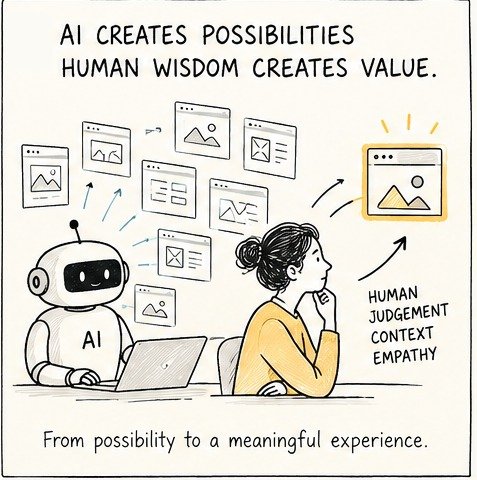
AI can dramatically expand the field of possibility. It can show us ten directions where previously we might have explored two. Future design advances will almost certainly increase that number again. Generative systems can challenge assumptions, accelerate experimentation and expose directions that may never have occurred to us.
But possibility is not the same as meaning.
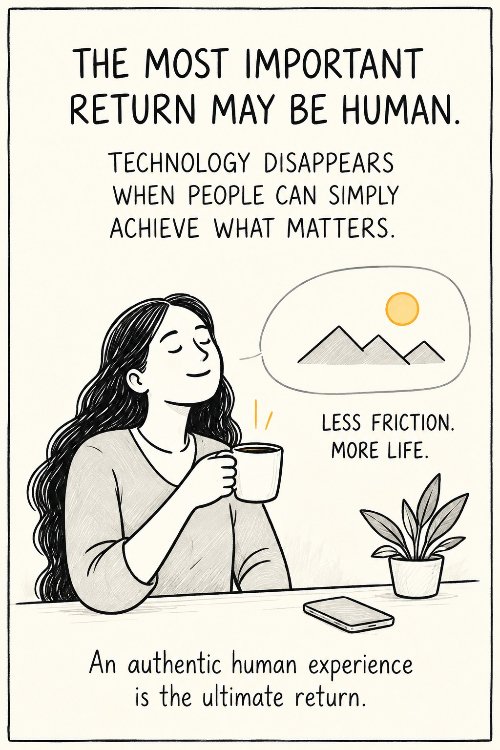
The best technology often disappears from conscious attention. What remains is the human experience it made possible.
Meaning emerges through selection.
Someone still has to decide which possibility is appropriate, which one respects the person using it and which one understands the circumstances in which it will be encountered. Someone has to weigh the compromises and recognise when an apparently efficient solution quietly diminishes the experience of the human being expected to use it.
In that sense, UX is not merely a human layer added after AI generates something.
The act of thinking through the possibilities is itself part of the design.
When AI generates a hundred plausible directions, value does not reside only in those hundred outputs. Value is created through examining them, rejecting most of them, combining others, questioning their assumptions and deciding what deserves to remain.
That process is an exercise in judgement. It draws on more than information. It requires experience, empathy, memory, intuition, cultural understanding and an appreciation of consequences.
At its best, UX requires one human being to imagine the experience of another.
This is where the idea of an authentic human experience needs care.
Authenticity does not mean that every pixel must be manually created by a person. Nor does it require us to romanticise inefficient processes simply because they are human. An authentic experience is one in which the technology feels appropriately aligned with the intention, circumstances and humanity of the person using it.
AI can contribute enormously to producing that experience. It can increase the breadth of exploration and remove mechanical effort that once consumed the designer's attention.
The important question is what we do with the freedom that creates.
When execution was difficult, much of our attention naturally rested on the artefact: the screen, the interface, the component and the finished product. When execution becomes almost effortless, our attention is forced upstream towards intention.
We must decide what deserves to exist. We must decide what kind of experience it should create. And we must distinguish between possibilities that genuinely serve human beings and those that merely demonstrate what the technology is capable of producing.
Those are profoundly human decisions.
Perhaps, then, the deepest ROI of UX Design is not simply that better experiences produce better commercial outcomes. It is that thoughtful design preserves something increasingly precious in an age of synthetic abundance: an authentic human experience.
AI may give us more creative possibilities than any generation before us. The wisdom to choose among those possibilities may become our most important creative act.
One of the most persistent assumptions surrounding AI is that competitive advantage will belong to organisations with access to the most sophisticated tools. That advantage is unlikely to endure. AI capabilities will continue to improve, spread and become increasingly affordable. Execution is already becoming a commodity, and competitive advantage rarely survives commoditisation for long.
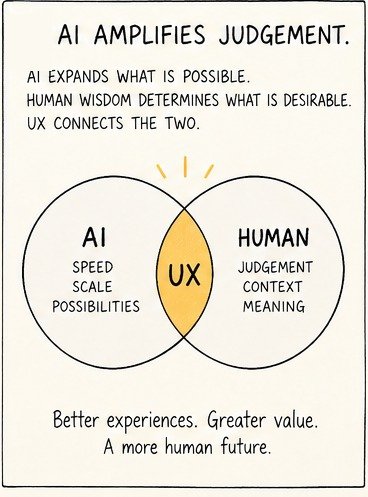
An effective design process therefore begins to resemble a partnership rather than a replacement. Human insight frames the problem. AI expands the possibility space. Human judgement constrains that space. AI accelerates execution. Humans observe the consequences, learn from the response and refine the experience.
In other words, AI expands what is possible, human wisdom determines what is desirable, and UX connects the two.
This is why increasingly capable AI does not make human-centred design obsolete. It increases the leverage of good judgement while simultaneously increasing the consequences of bad judgement.
When production becomes cheap, mistakes can also be produced at scale.
There is a paradox at the centre of AI-driven design. As interfaces become easier to generate, meaningful experiences become harder to distinguish. When execution becomes cheaper, understanding becomes more valuable. If knowledge becomes abundant, judgement becomes scarce.
And as artificial systems become increasingly capable of imitating the products of human creativity, we are being forced to examine more carefully what was valuable about the human contribution in the first place.
Perhaps that is one of AI's unexpected gifts to the design profession.
It has reminded us that UX was never fundamentally about moving pixels, following trends or producing beautiful screens.
Those were visible manifestations of a deeper activity: understanding another human being well enough to create technology that serves their intention.
The best experiences often disappear from conscious attention. The person does not stop to admire the information architecture, interaction pattern or carefully considered sequence of decisions that made the experience possible. They simply accomplish what they came to do, with confidence and without unnecessary friction.
For the customer, that creates trust and progress. For the organisation, it creates adoption, efficiency, loyalty, differentiation and sustainable growth. These are the measurable returns of UX.
Beneath them, however, lies something more fundamental.
Artificial intelligence can generate possibilities at a scale we have never experienced before. Human beings still determine which of those possibilities deserve to become part of another person's life.
That act of selection—applying context, judgement, empathy and responsibility to possibility—is not merely a residual task left over because AI is not yet capable enough. It may be the very essence of design.
The ROI of UX Design therefore extends beyond the cost of making an interface or the revenue generated by improving one. It begins with better decisions, manifests as better experiences and ends in both human and commercial value.
AI has commoditised execution. Wisdom has become the scarce resource. UX turns that wisdom into an authentic human experience, and authentic human experience is ultimately where enduring value begins.
Subscribe to get the best and most popular insights each month